What Is an Emergency Medical Condition (EMC)? How It Unlocks the Full $10,000 in Florida PIP Benefits

The moments following a car accident on the I-4 or the Palmetto Expressway are often a blur of adrenaline and confusion. You might feel a strange "pins and needles" sensation in your arms, or perhaps your neck feels stiff, like it's been locked in a vice. In the chaos of trading insurance info and waiting for a tow truck, your body is essentially lying to you. Adrenaline masks pain, and that "minor" soreness you feel today could be the start of a life-altering injury.
In Florida, there is a hidden rule that many drivers don’t discover until it’s too late: your insurance company isn't required to give you your full benefits just because you pay your premiums. To access the full $10,000 you've been promised under your PIP insurance Florida policy, you need more than just a "sore back", you need a specific medical designation known as an Emergency Medical Condition (EMC).
Without this "golden ticket" in your medical file, your benefits are slashed by 75%, leaving you with a maximum of just $2,500 to cover your recovery.
The 14-Day Clock: Your First Vital Deadline
Before we even talk about the money, we have to talk about the clock. Florida law is very clear: you have exactly 14 days from the date of your accident to seek medical treatment. If you wait until day 15 because you thought the pain would "just go away," you have forfeited your $10,000 in Personal injury protection Florida benefits entirely.
Think of this 14-day window as the "activation period" for your insurance. It doesn't matter if you were rear-ended at a red light in Tampa or side-swiped on I-95 in Miami; the law applies to everyone equally. Seeking an evaluation at an accident injury clinic within this window is the only way to ensure your claim stays alive.
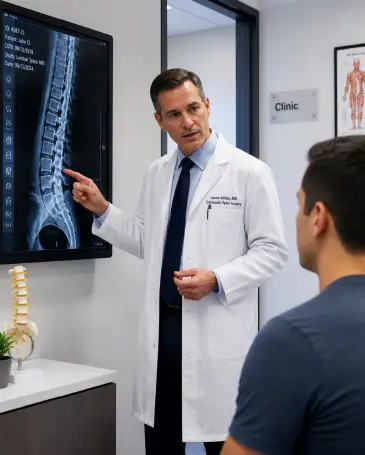
The $2,500 Trap vs. The $10,000 Shield
Most people assume that because they have $10,000 in coverage, that money is sitting in a vault waiting for them. The reality is that Florida PIP is a two-tiered system:
1. The Non-EMC Tier ($2,500): If your injuries are deemed "non-emergency," your medical benefits are capped at $2,500. After a few rounds of diagnostic tests and initial treatments, that money is gone, leaving you to pay out-of-pocket for the rest of your care.
2. The EMC Tier ($10,000): When a qualified medical professional determines you have an Emergency Medical Condition, the "cap" is lifted, and the full $10,000 becomes available for your treatment and lost wages.
Why does this matter? Consider a typical neck injury. A single MRI can cost upwards of $1,500. If you are stuck in the $2,500 tier, you will run out of insurance money before you even begin your actual rehabilitation. An EMC diagnosis is the shield that protects your bank account while you focus on healing.
What Exactly Is an "Emergency Medical Condition" (EMC)?
The legal definition of an EMC can sound like a lot of "medical-speak," but it essentially means that your injury is serious enough that it could cause long-term damage if it isn't treated immediately.
Under Florida Statute § 627.736, an EMC is a medical condition manifesting itself by acute symptoms of sufficient severity (which may include severe pain) such that the absence of immediate medical attention could reasonably be expected to result in:
• Serious jeopardy to patient health.
• Serious impairment to bodily functions.
• Serious dysfunction of any bodily organ or part.
Think about a concussion. When your car is hit, your brain doesn't just stop; it bounces inside your skull like a marble in a jar. That "bouncing" can cause microscopic tearing and swelling. To the untrained eye, you might just have a headache. To a professional at an accident injury clinic, that is a potential EMC that requires immediate intervention to prevent permanent cognitive dysfunction.
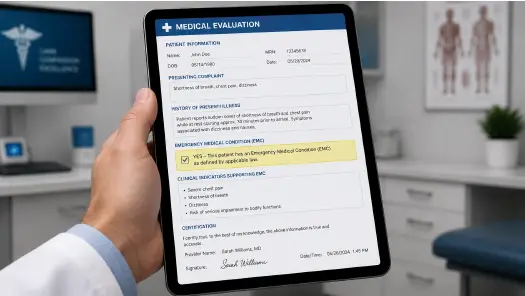
Who Can "Unlock" Your Benefits?
This is where many accident victims get tripped up. Not every healthcare provider has the legal authority to declare an EMC in the state of Florida. To unlock the full $10,000 in Florida PIP benefits, the diagnosis must come from:
• A Medical Doctor (MD)
• An Osteopathic Physician (DO)
• A Physician Assistant (PA)
• An Advanced Practice Registered Nurse (APRN)
• A Dentist (for jaw/facial injuries)
The Role of Your Chiropractor: While chiropractors are the experts in treating the spinal misalignments and soft-tissue damage common in car accidents, Florida law does not currently allow a chiropractor to officially sign off on the EMC determination itself.
However, this does not mean you shouldn't see a chiropractor. In fact, our accident injury clinic network is designed specifically to handle this. When you come to us, our chiropractors perform the detailed evaluations and X-rays needed to document your injuries. We then work alongside MDs and Nurse Practitioners who review your clinical findings to determine if an EMC exists. This collaborative approach ensures you get the specialized care you need while also securing the documentation required by your insurance company.
Why Avoid the Emergency Room for Your Evaluation?
Many people head straight to the ER after a crash, thinking it's the only way to prove they are hurt. While the ER is vital for life-threatening emergencies, it is often the wrong choice for "routine" accident injuries like whiplash or disc herniations.
• Long Wait Times: You could spend 6 to 10 hours in a waiting room surrounded by people with contagious illnesses.
• The "ER Discharge" Trap: ER doctors are looking for life-or-death issues. If you aren't bleeding or broken, they often discharge you with a "minor strain" diagnosis. This "minor" label can be used by insurance companies to deny your EMC later.
• Massive Bills: A single ER visit can easily exceed $5,000, wiping out half of your PIP benefits in one night before you've even seen a specialist.
Choosing a specialized car accident clinic means you get an evaluation tailored to the biomechanics of a vehicle collision, usually with much shorter wait times and a focus on the long-term documentation your claim needs.
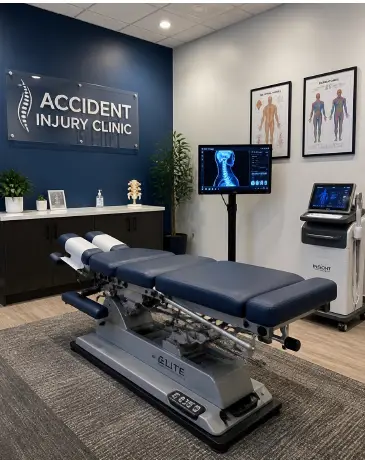
Don't Let "Feeling Fine" Cheat You Out of Care
We hear it every day: "I felt okay right after the hit, so I didn't think I needed a doctor." This is the most dangerous misconception in Florida accident law.
Injuries like whiplash, spinal disc bulges, and soft tissue tears are notorious for having a delayed onset. You might feel fine on Monday, but by Thursday, you can't turn your head to check your blind spot while driving down Colonial Drive. By the time the pain becomes unbearable, you might be past your 14-day window, or your insurance company might argue that your pain was caused by something else.
Proactive documentation is your best defense. Getting an evaluation immediately, even if you feel "mostly okay", creates a paper trail that connects your injuries directly to the accident.
Call 855-Sched-it Today
Navigating the aftermath of an accident is stressful enough without having to worry about insurance caps and legal definitions. Let us be the steady hand that guides you through the chaos. At The Medical Scheduling Department LLC, we specialize in connecting accident victims with the right clinics to ensure their 14-day rule is met and their EMC is properly documented.
Do not wait for the pain to get worse. Secure your benefits and start your recovery now.
Call us at 855-Sched-it (855-724-3348) to schedule your evaluation.

Frequently Asked Questions (FAQ)
Q: Can I get an EMC diagnosis if I only have whiplash? A: Yes. Whiplash can be a severe condition that causes "serious impairment of bodily function," such as loss of range of motion or nerve impingement. If your symptoms are acute and severe, a qualifying medical professional can determine it is an EMC.
Q: What happens if my insurance company disagrees with the EMC? A: Insurance companies often try to "peer review" claims to save money. This is why having detailed medical records, X-rays, and a clear statement from a medical professional at a reputable accident injury clinic is so critical. It makes it much harder for them to dispute your care.
Q: Does the $10,000 cover my car repairs? A: No. Florida PIP benefits are for medical expenses and lost wages only. Damage to your vehicle is covered under your Property Damage (PD) coverage or the at-fault party's insurance.
Q: I didn't go to the doctor within 14 days. Can I still get an EMC? A: You can still be diagnosed with a medical condition, but your insurance company will likely deny payment for any treatment under your PIP policy. The 14-day rule is a hard deadline for insurance coverage in Florida.
Q: Will my insurance rates go up if I use my PIP? A: Florida law generally prohibits insurance companies from raising your rates for a "no-fault" claim unless they determine you were substantially a fault for the accident.
__________________________________________________________________________________
STATUTORY DISCLOSURES AND LEGAL DISCLAIMERS The Medical Scheduling Department LLC is a medical scheduling service and not a law firm or a medical provider. This article is for informational purposes only and does not constitute legal or medical advice. Under Florida Statute § 627.736, Personal Injury Protection (PIP) benefits are subject to specific limits, deductibles, and requirements. The $10,000 benefit is the statutory maximum and is subject to the 80/60 rule (80% of medical bills and 60% of lost wages). An Emergency Medical Condition (EMC) must be determined by a provider authorized under Florida law (MD, DO, PA, APRN, or Dentist). Chiropractors are vital treatment providers but cannot legally render the final EMC determination for the purposes of unlocking the $10,000 cap. Always consult with a qualified medical professional for diagnosis and a licensed attorney for legal advice regarding your specific accident claim.
